Developments in Turkey
1. Increase in Cargo Traffic at Turkish Ports
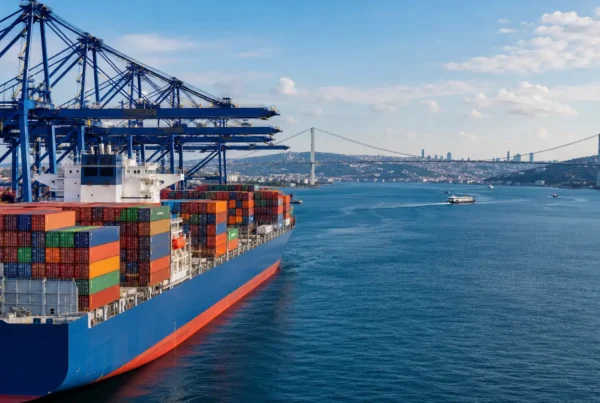
In September 2025, total cargo traffic at Turkish ports increased by approximately 2.8% year-on-year, marking a 3% growth in cumulative terms for the January–September period. (Ports Europe, 2025)
This upward trend reflects improved operational capacity and logistics performance at Turkish ports, although the pace remains below global averages.
2. New Maritime Regulations Related to Israel
Turkey implemented new maritime regulations affecting ships and port operations linked to Israel. Incoming vessels must now submit an official declaration confirming no connection to Israel. (BIMCO, 2025)
Meanwhile, reports indicate that foreign-flagged ships continue to transport cargo from Turkish ports to Israel. (Turkish Minute, 2025)
This reflects the complex interplay between regional politics and maritime operations, adding new compliance requirements for shipping and port operators.
3. Regional Naval and Security Activities
In September, a NATO maritime task group conducted electronic warfare (EW) readiness exercises off the Turkish coast. (NATO Media Centre, 2025)
Such exercises highlight the dual commercial and strategic importance of maritime activity, particularly regarding port security and sea-lane protection.
International Developments
1. Global Maritime Trade Growth Slows
According to UNCTAD’s Review of Maritime Transport 2025, global maritime trade growth remains weak. (UN Newsroom, 2025)
The report attributes this slowdown to geopolitical uncertainty, increased costs, and extended shipping routes. (S&P Global, 2025)
These factors underscore the need for resilience and adaptability across the shipping and port sectors.
2. Container Shipping Faces Competitive and Margin Pressure
The container shipping market, particularly along the Asia–Europe route, continues to face margin compression and volatile freight rates. (AXS Marine, 2025)
This reflects ongoing challenges in demand patterns, port congestion, and expanded fleet capacity since the post-pandemic recovery.
3. Environmental Regulations and Industry Response
The International Maritime Organization (IMO) has reaffirmed its environmental commitment with the 2025 theme “Our Ocean – Our Responsibility – Our Opportunity.” (IMO, 2025)
Meanwhile, shipping companies have renewed calls for a global greenhouse gas levy, intended to accelerate decarbonization across the sector. (AP News, 2025)
This marks a crucial shift toward sustainability, requiring significant investment from shipowners, operators, and port authorities alike.
References
-
Turkey’s port cargo rises 2.8% in September 2025, Ports Europe, 14 Oct 2025.
-
Third-country vessels still carrying cargo to Israel from Turkish ports, Turkish Minute, 9 Sep 2025.
-
Türkiye introduces new restrictions on ships linked to Israel, BIMCO News & Insights, 12 Sep 2025.
-
NATO sharpens Allied electronic warfare readiness during exercise Dynamic Guard, NATO Media Centre, 9 Sep 2025.
-
Maritime trade growth to stall in 2025 on geopolitical volatility and higher costs, GTR Review, 24 Sep 2025.
-
Fragile growth, greater uncertainty, volatile freight rates for shipping: UN, S&P Global Commodity Insights, 24 Sep 2025.
-
Notable Container Shipping News: September 2025, AXS Marine Blog, 7 Oct 2025.
-
World Maritime Day 2025: Global Shipping Industry Confronts Ocean Protection amid Trade Slowdown, gCaptain, 25 Sep 2025.
-
Shipping companies support a first-ever global fee on greenhouse gases, AP News, 21 Sep 2025.
-
Tariffs and conflict causing major volatility in shipping industry, Reuters, 24 Sep 2025.