April 2026 Maritime Developments: Key Highlights in Türkiye and Global Shipping
April 2026 brought important developments for the maritime industry, both in Türkiye and across global shipping markets. In Türkiye, cruise traffic, port operations and towage service areas stood out as key topics. On the global side, IMO environmental decisions, progress on the HNS Convention, security risks in the Strait of Hormuz and continued uncertainty around the Suez–Red Sea route shaped the maritime agenda.
National Maritime Developments
Cruise Traffic Continued to Gain Momentum in the First Quarter
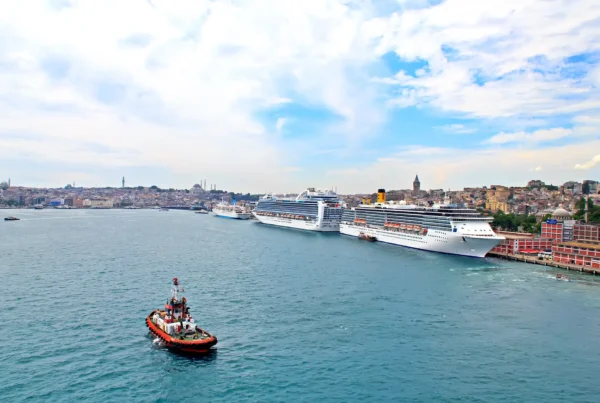
One of the most notable maritime topics in Türkiye in April was cruise tourism. According to data announced by the Ministry of Transport and Infrastructure, 56 cruise ships called at Turkish ports in the first quarter of 2026, carrying a total of 93,787 cruise passengers. In March alone, 26 cruise ships visited Turkish ports, while the number of cruise passengers reached 41,039, marking the highest March figure in the last 16 years. [1]
This outlook shows that İstanbul, Kuşadası and İzmir Alsancak ports continue to maintain a strong position in cruise operations. In the first three months of the year, İstanbul ports ranked first with 18 cruise ship calls and 35,800 passengers. [1]
First-Quarter Port, Cargo, Container and Ro-Ro Statistics Remained Important
The Directorate General of Maritime Affairs continued to publish monthly statistics for cargo, container, Ro-Ro vehicle movements and ship calls in 2026. As of April, many datasets included January–March 2026 figures, while several April pages were still in the process of being updated. [2]
For this reason, April assessments should be based on the latest officially published dataset, which covers the first quarter of 2026. These figures are important for port operators, shipping agencies, cargo owners and logistics companies in terms of seasonal planning, capacity management, line performance and operational priorities.
Tender Process for Towage Service Areas
Another important item on Türkiye’s maritime agenda in April 2026 was the tender schedule for regional towage service areas. According to the planning published by the Directorate General of Maritime Affairs, tender dates in April covered regional service areas including İskenderun, Tekirdağ, Tuzla, Kocaeli-2 and Yalova. [3]
Towage services play a critical role in berthing, unberthing, manoeuvring safety and operational continuity. Therefore, the regulation of service areas should not be evaluated only as a tender process, but also as an important factor for port safety and sustainable maritime operations.
Maritime Safety, Search and Rescue, and Environmental Inspections
In April, the Turkish Coast Guard Command’s activities highlighted search and rescue, irregular migration, illegal fishing, smuggling and marine pollution. In its 17 April 2026 activity report, the Coast Guard announced that 32 irregular migrants had been rescued, administrative actions had been taken against illegal fishing and illegal fuel had been detected. The 30 April 2026 activities also included operations related to search and rescue, marine pollution and illegal fishing. [4]
These developments show that operational safety in the maritime industry is not limited to commercial activities. Protection of the marine environment, navigational safety, migration movements and the fight against smuggling are integral parts of the maritime ecosystem.
Turkish Straits and Operational Planning
The Turkish Straits vessel traffic direction and traffic suspension/opening information published by the Directorate General of Coastal Safety continued to be critical for planning passages through the İstanbul and Çanakkale Straits. For shipping agencies, shipowners and operations teams, this information directly affects transit passage planning, waiting times and the timing of port-related operations. [5]
Global Maritime Developments
IMO MEPC 84 and Environment-Focused Decisions
The 84th session of the IMO Marine Environment Protection Committee, which began at the end of April, brought important decisions for global maritime regulation. IMO adopted a new Emission Control Area for the North-East Atlantic, introducing stricter limits for NOx, SOx and particulate matter. The new ECA is expected to enter into force on 1 September 2027 and become applicable in 2028. [6]
During the same process, IMO also adopted the 2026 Strategy and Action Plan to address marine plastic litter from ships. This plan supports the goal of eliminating plastic waste discharges from ships into the sea and highlights port waste reception facilities, seafarer training and international cooperation. [6]
The HNS Convention Moved Closer to Entry into Force
In April 2026, an important step was taken regarding the HNS Convention, which covers liability and compensation for damage caused by the carriage of hazardous and noxious substances by sea. Belgium, Germany, the Kingdom of the Netherlands and Sweden deposited their instruments of ratification for the 2010 HNS Convention with IMO, meeting one of the key criteria required for the convention’s entry into force. [7]
Once the HNS regime enters into force, it will provide a more comprehensive liability and compensation mechanism for damage caused during the transport of hazardous and noxious substances by sea. This development should be closely monitored by stakeholders involved in chemical cargoes, alternative fuels and dangerous goods transportation.
Strait of Hormuz and Maritime Trade Security
One of the most critical global maritime security topics in April was the Strait of Hormuz. According to Reuters’ report dated 24 April, only five ships passed through the Strait of Hormuz within the previous 24 hours. This was significantly lower than the pre-war daily average of around 140 transits. The same report stated that hundreds of vessels and nearly 20,000 seafarers were waiting inside the Gulf. [8]
Uncertainty in the Strait of Hormuz is putting direct pressure on energy transportation, insurance costs, freight rates and voyage planning. For maritime companies, this period shows that route security and crew safety have become more important than commercial speed.
Suez, Red Sea and the Pressure of Alternative Routes
Security risks in the Red Sea and Suez route continued to push vessels toward longer routes around the Cape of Good Hope. According to Reuters, major container lines redirected voyages around Africa due to tensions in the Middle East, creating expectations of potential traffic growth at ports such as Tanger Med, which connects the Mediterranean and Atlantic routes. [9]
Longer routes increase transit times while adding pressure on fuel consumption, freight costs, insurance premiums and crew planning. For this reason, “route flexibility” and “resilient supply chains” remain among the main themes of global maritime transportation in 2026.
Net-Zero Framework and Decarbonization Uncertainty
The IMO Net-Zero Framework discussions at the end of April remained highly important for the decarbonization of international shipping. According to the Global Maritime Forum, IMO’s net-zero framework includes elements such as a global fuel standard, emission intensity targets, a penalty mechanism, incentives for low-emission fuels and credit trading. [10]
However, uncertainty around the adoption process and implementation timeline continues to affect shipowners’ decisions on alternative fuels, vessel investments and long-term contracts. Therefore, maritime companies must focus not only on compliance with current regulations, but also on preparing for future emission-related costs.
Main Takeaways from the April 2026 Maritime Agenda
For Türkiye
Türkiye’s maritime agenda in April 2026 was shaped by cruise passenger growth, first-quarter port statistics, regulation of towage service areas and maritime safety activities. The increase in cruise traffic once again highlighted the strong potential of Turkish ports in terms of tourism, service quality and operational coordination.
For the Global Maritime Industry
Globally, the key maritime topics of April 2026 were IMO environmental decisions, the liability regime for hazardous cargoes, security risks in the Strait of Hormuz, route uncertainty across the Suez–Red Sea corridor and decarbonization regulations. These developments show that operational flexibility, environmental compliance and risk management are becoming increasingly critical for the maritime industry.
Conclusion
April 2026 was a month in which both opportunities and risks became more visible for the maritime industry. In Türkiye, positive indicators stood out in cruise and port operations, while geopolitical risks and environmental regulations continued to shape the global maritime agenda. In the coming period, success in the maritime industry will depend not only on fast operations, but also on building safe, sustainable, data-driven and route-flexible operational structures.
References
National Sources
[1] Republic of Türkiye Ministry of Transport and Infrastructure, “Kruvaziyer Yolcu Sayısı Son 16 Yılın En Yüksek Seviyesinde”, 10 April 2026.
[2] Republic of Türkiye Ministry of Transport and Infrastructure, Maritime Statistics, “Cargo Statistics 2026” and “Ship Statistics 2026”.
[3] Republic of Türkiye Ministry of Transport and Infrastructure, Directorate General of Maritime Affairs, “Planned Towage Tenders”.
[4] Turkish Coast Guard Command, “Current Activities — 17 April 2026” and “Current Activities — 30 April 2026”.
[5] Directorate General of Coastal Safety, “Turkish Straits Vessel Traffic Direction”.
Global Sources
[6] International Maritime Organization, “IMO progresses work on ship emissions, pollution and ocean protection”.
[7] International Maritime Organization, “Hazardous cargo compensation regime moves to entry into force”, 14 April 2026.
[8] Reuters, “Only five ships pass through Strait of Hormuz in 24 hours”, 24 April 2026.
[9] Reuters, “Morocco’s Tanger Med port expects increased traffic amid Gulf war”, 30 March 2026.
[10] Global Maritime Forum, “A guide to the IMO’s Net-Zero Framework”, 20 April 2026.