May 2026 was a month marked by significant developments in the maritime industry, both in Türkiye and across the global market. In Türkiye, port performance, the strategic role of the Turkish Straits, port-connected transport investments and regulatory steps regarding tugboat service areas stood out.
On the global side, IMO decisions on the environment, emissions, autonomous ships and maritime safety remained high on the industry agenda. In particular, the IMO MEPC 84 meeting, the adoption of a new Emission Control Area, the MASS Code for autonomous ships and security risks around the Strait of Hormuz were among the key developments of May 2026.
As some official port and vessel statistics for May 2026 had not yet been updated at the time of publication, this article is based on official April 2026 data published in May and current announcements made during the month. [1] [2]
National Maritime Developments
For Türkiye’s maritime sector, the main agenda in May 2026 included port performance, vessel traffic through the Turkish Straits, railway investments connected to ports and regulatory processes concerning tugboat service areas.
Türkiye’s Ports Set an April Record, Announced in May
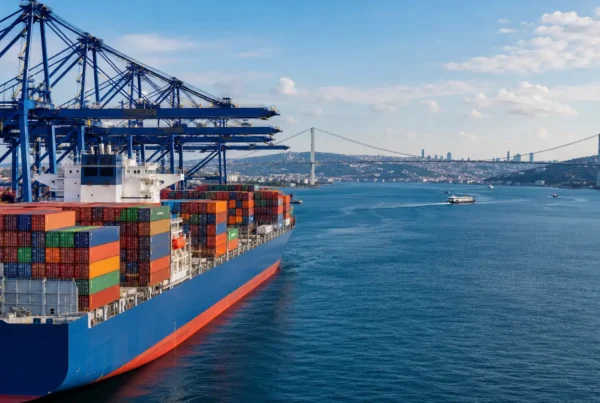
According to figures announced by the Ministry of Transport and Infrastructure in May, Turkish ports handled 48,230,930 tons of cargo and 1,179,454 TEU of containers in April 2026. These figures were announced as the highest April levels ever recorded. [3]
In the January-April 2026 period, the total amount of cargo handled at Turkish ports increased by 2.1 percent compared to the same period of the previous year, reaching 185,600,883 tons. Container handling volume rose by 2.4 percent to 4,550,209 TEU in the same period. [1] [3]
These figures show that Turkish ports continue to maintain their strong position in regional trade. The growing operational volume in containers, general cargo, bulk cargo and transit transportation demonstrates that ports are not only cargo handling points, but also important links in international logistics networks.
İskenderun, Kocaeli and Aliağa Led Cargo Handling Volumes
In April 2026, the highest cargo handling volume was recorded within the administrative boundaries of the İskenderun Regional Port Authority. İskenderun was followed by Kocaeli and Aliağa. These three regions remain among Türkiye’s critical port centers for industrial production, energy logistics, export operations and raw material transportation. [1] [3]
İskenderun’s leading position in cargo handling once again highlighted the logistics potential of the Eastern Mediterranean and the region’s importance in maritime transportation. Kocaeli and Aliağa also maintained their roles as Türkiye’s main maritime trade centers with their industrial facilities, energy terminals and foreign trade cargoes.
The Strategic Importance of the Turkish Straits Returned to the Agenda
In May, the crisis around the Strait of Hormuz brought the importance of critical maritime chokepoints back to the global trade agenda. In this context, the strategic position of the Turkish Straits for the Black Sea, the Mediterranean, energy transportation and global supply chains once again came to the forefront.
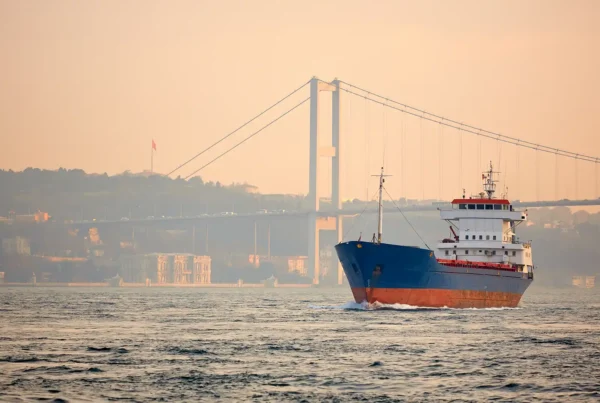
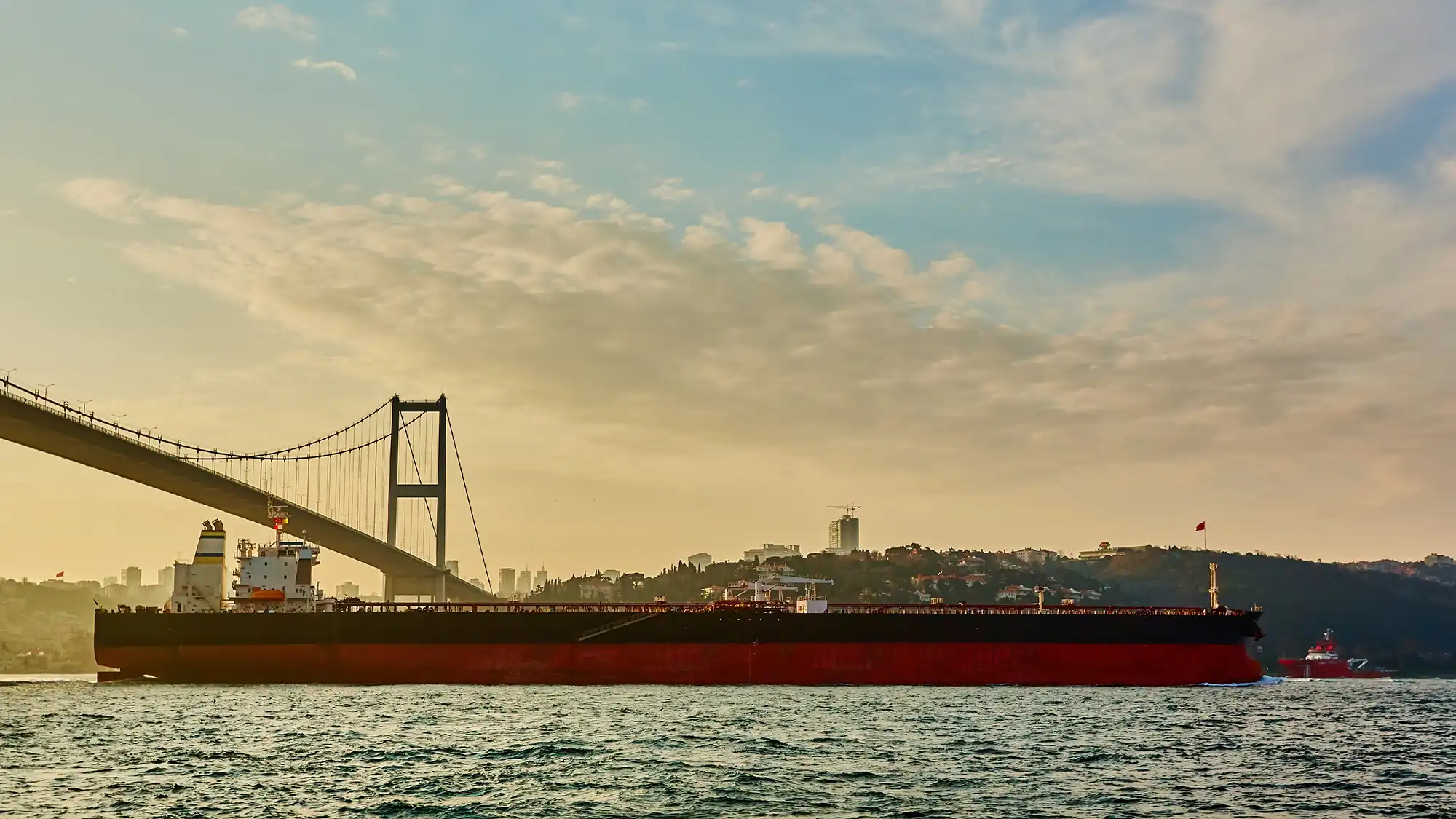
According to data announced by the Ministry of Transport and Infrastructure, 12,565 vessels passed through the Istanbul Strait and 13,649 vessels passed through the Çanakkale Strait in the first four months of 2026. This brought total vessel traffic through the Turkish Straits to 26,214. During the same period, 15,639 pilotage services were provided. [4]
These figures show the importance of safe passage, traffic management, pilotage services and operational coordination in the Turkish Straits. In periods of increasing geopolitical risk, strait passages become more important not only for route planning, but also for insurance, freight, safety and environmental risk management.
A New Tender Process Started for Tugboat Service Areas
In May, the Directorate General of Maritime Affairs announced tenders for the transfer of operating rights for tugboat services in the Gemlik and Kocaeli-3 regional service areas. For both service areas, the tender process covers a 20-year operating rights transfer. [6]
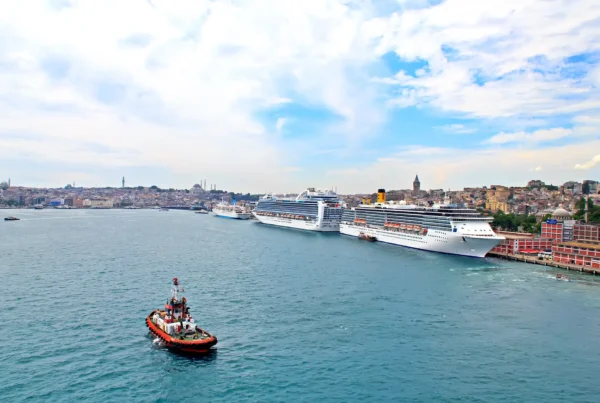
Tugboat services are among the core elements of port safety and vessel maneuvering operations. Tugboat capacity is critical for operational safety, especially in port regions with heavy vessel traffic, large-tonnage vessels, dangerous cargo operations and restricted maneuvering areas.
For this reason, regulations and tender processes regarding tugboat service areas are developments that should be closely monitored not only by service providers, but also by port operators, ship agents, shipowners and cargo stakeholders.
Logistics Investments Connected to Mersin and İskenderun Came to the Forefront
Transport investments connected to maritime logistics also held an important place on the sector agenda in May. According to announcements by the Ministry of Transport and Infrastructure, the Mersin-Adana-Osmaniye-Gaziantep High-Speed Railway Line will strengthen the connection of Mersin ports with the Middle Corridor and the Development Road. The project has a target of carrying approximately 37.1 million tons of cargo annually. [5]
Similarly, the Dörtyol-Hassa Railway and Highway Project is expected to strengthen the hinterland of İskenderun Port and accelerate sea access for production centers in Southeastern and Eastern Anatolia. [5]
These investments show that ports should not be evaluated separately from the broader transport network. The efficiency of port operations gains greater strategic value when considered together with railway connections, road access, logistics centers, industrial zones and international trade corridors.
Global Maritime Developments
In the global maritime agenda, environmental regulations, emission reduction, autonomous ships, maritime safety and geopolitical risks stood out in May 2026. IMO decisions remained among the most important factors shaping the medium- and long-term transformation of the sector.
Emission and Environmental Issues Were Addressed at IMO MEPC 84
The 84th session of the IMO Marine Environment Protection Committee was held in London between 27 April and 1 May 2026. The meeting addressed issues such as the reduction of greenhouse gas emissions from ships, marine pollution, plastic litter, ballast water management and emission control areas. [7]
It was decided that work would continue to strengthen consensus among member states on the IMO Net-Zero Framework. In addition, intersessional working meetings are planned for September and November 2026 in order to advance technical issues before MEPC 85. [7]
These developments show that environmental compliance has become an integral part of operational planning in the maritime industry. For shipowners, operators, charterers, ports and agents, emission regulations will continue to have a direct impact on fuel selection, route planning, fleet renewal, reporting and operational costs.
A New Emission Control Area Was Adopted for the North-East Atlantic
One of the key decisions taken at MEPC 84 was the adoption of a new Emission Control Area for the North-East Atlantic. This area will introduce stricter standards for nitrogen oxides, sulphur oxides and particulate matter emissions. The decision is expected to enter into force on 1 September 2027 and become effective in 2028. [7]
The new Emission Control Area is a development that should be closely monitored, especially by vessels engaged in Europe-connected maritime trade. Fuel quality, engine compliance, exhaust gas cleaning systems, route planning and voyage costs are among the areas that may be directly affected by this regulation.
This decision shows that regional environmental regulations in maritime transport are expanding and that emission reduction policies are becoming more decisive in vessel operations.
The First Global Code for Autonomous Ships Was Adopted
At the 111th session of the IMO Maritime Safety Committee, the first global safety code for maritime autonomous surface ships was adopted. Known as the MASS Code, this framework aims to ensure the safe integration of remotely operated or autonomous commercial ships into the maritime system. [8]
The Code is planned to enter into force on 1 July 2026 and will initially be implemented as a non-mandatory framework. According to IMO’s roadmap, the mandatory MASS Code is targeted for adoption in 2030 and entry into force in 2032. [8]
This development shows that digitalization and automation in maritime transport have entered a new phase. With autonomous ships, many areas such as remote operation centers, AI-supported navigation systems, cybersecurity, the responsibility of the ship’s master, insurance processes and maritime law will need to be reassessed.
Risks Around Hormuz Affected the Maritime Safety Agenda
The crisis around the Strait of Hormuz created an important maritime security agenda in May. Attacks against commercial vessels were closely followed by the industry due to their potential impact on energy transportation, oil shipments, insurance premiums, route planning and crew safety.
IMO adopted decisions regarding attacks against commercial vessels and their possible effects on the marine environment. In particular, risks related to oil, hazardous and noxious substances, fire, explosion and marine pollution were emphasized. [7]
This picture shows that wars and geopolitical tensions affect the maritime industry not only through freight rates or route changes. Crew safety, environmental risks, insurance costs, port operations, waiting times and supply chain continuity are also directly affected by such crises.
Women’s Employment and Equality in Maritime Came to the Forefront
On the occasion of the International Day for Women in Maritime on 18 May, IMO once again brought gender equality and women’s employment in the maritime sector to the agenda. The 2026 theme focused on moving from policy to practice and strengthening measurable equality steps in the industry. [9]
According to IMO data, women make up less than 20 percent of the shore-based maritime workforce and less than 2 percent of seafarers. [9]
These figures show that human resources policies in maritime should not be limited to training and certification. Career access, safe working environments, equal opportunities, mentoring programs and sustainable employment models are becoming increasingly important for the future of the industry.
What May 2026 Means for the Maritime Industry
The developments of May 2026 showed that three main trends are becoming stronger in the maritime sector. The first was the strong performance of Turkish ports in cargo and container handling. The record figures announced for ports created a positive outlook for Türkiye’s goal of becoming a regional logistics hub.
The second major trend was the increasing strategic importance of straits and critical chokepoints. While the crisis around the Strait of Hormuz showed the importance of safe passage and alternative route planning in maritime trade, the role of the Turkish Straits in global trade also came back into focus.
The third trend was the environment-, technology- and safety-oriented transformation of the sector. IMO decisions showed that emission compliance, alternative fuels, digitalization, autonomous ships and maritime safety will become more decisive in the future of the industry.
Efficiency in Port Operations Is Becoming More Critical
Increasing cargo and container volumes make planning, yard management, berth efficiency and coordination between stakeholders more important in port operations. Communication between ship agents, terminal operators, cargo owners, customs authorities and logistics companies continues to play a decisive role in operational success.
The Emission Compliance Process Will Affect Operational Costs
IMO decisions and new emission control areas make fuel selection, route planning, technical compliance and reporting processes more important for ship operators. This will be a factor that shipowners and charterers, especially those involved in Europe-connected transportation, need to consider in cost planning.
Geopolitical Risks Will Shape Route and Insurance Planning
Crises in Hormuz and similar critical chokepoints increase the operational and financial impact of security risks in maritime trade. Route changes, waiting times, insurance costs and crew safety will remain among the key issues to follow closely in the second half of 2026.
Conclusion
The maritime developments of May 2026 showed that the industry can no longer be evaluated only in terms of carrying capacity. Environmental compliance, technological transformation, safe passage, port connections and geopolitical resilience have become equally important.
For Türkiye, port performance, vessel traffic through the Turkish Straits and port-connected transport investments presented a strong picture. On the global scale, IMO decisions showed that new rules and new operational standards are on the way for the maritime industry.
In the second half of 2026, emission regulations, autonomous ship applications, security risks in Hormuz and similar critical chokepoints, tugboat and pilotage services, port-connected logistics investments and human resources policies will continue to be among the main agenda items of the maritime sector.