Maritime Updates – June 2026
June 2026 was a significant month for the maritime industry, with safety, port-connected transport investments, cruise tourism, environmental compliance and digitalization standing out both in Türkiye and across the global maritime sector.
In Türkiye, the main agenda included the opening of the new Gelibolu Ferry Terminal, the strengthening of the Middle Corridor through the Halkalı-Kapıkule High-Speed Railway Line, and the continued growth of cruise tourism. On the global side, security risks around the Strait of Hormuz, seafarer safety, IMO’s ocean policy agenda, biofouling, port digitalization and low-carbon shipping initiatives were among the key topics of the month.
As official cargo, container and cruise statistics for June 2026 had not yet been updated on the official data platforms at the time of publication, this article is based on official May 2026 data published in June and current announcements made during June 2026. [1] [2] [3]
National Maritime Developments
In June, port-connected transport investments, ferry infrastructure, cruise tourism and intermodal logistics connections stood out for Türkiye’s maritime sector. Maritime transport continued to be evaluated not only through port operations, but also as part of a broader logistics system that includes railways, road transport, passenger mobility and tourism.
Cruise Ship and Passenger Numbers Reached the Highest May Level in 14 Years
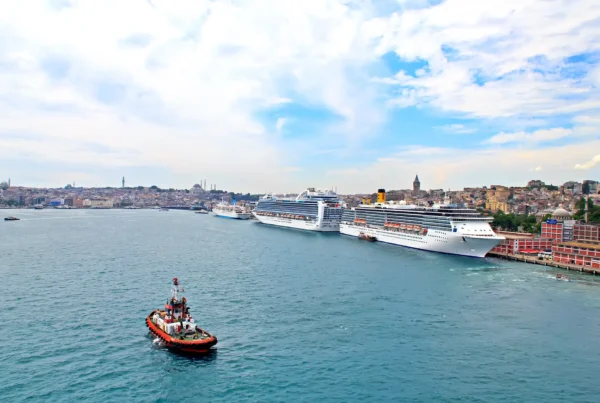
According to May 2026 cruise data announced by the Ministry of Transport and Infrastructure in June, the number of cruise ships calling at Turkish ports increased by 14.2 percent compared to the same month of the previous year, reaching 169. The number of cruise passengers rose by 10.8 percent to 257,897. With these figures, Türkiye reached the highest number of cruise ships and passengers recorded in May over the last 14 years. [3]
In the January-May 2026 period, the number of cruise ships calling at Turkish ports increased by 2.2 percent to 324, while the number of cruise passengers rose by 3.9 percent to 455,580. These figures indicate that Türkiye has entered a strong growth period in cruise tourism. [3]
Kuşadası, Istanbul and Bodrum stood out as the leading cruise destinations. In May, Kuşadası Port ranked first with 75 cruise ships and 127,670 passengers. Istanbul ports followed with 31 ships and 59,176 passengers, while Bodrum Port welcomed 11 ships and 10,889 passengers. [3]
This picture shows that Türkiye is strengthening its potential not only in cargo transportation, but also in cruise tourism and passenger port operations.
The New Gelibolu Ferry Terminal Was Opened
One of the key national maritime developments in June was the opening of the new Gelibolu Ferry Terminal. According to the Ministry of Transport and Infrastructure, the new terminal will add significant capacity to passenger and vehicle transportation on the Lapseki-Gelibolu route, with a 43,000-square-meter area, four berthing ramps, and parking capacity for 115 trucks and 340 vehicles. [4]
Ferry lines are among the critical components of road-sea integration, especially in the Marmara and Çanakkale regions. The new terminal investment is important for reducing waiting times in vehicle-passenger transportation, improving service continuity and increasing regional transport efficiency.
This investment also strengthens the role of maritime transport in daily mobility, tourism and logistics flows. Especially during peak seasons, ferry terminal capacity can directly affect regional traffic management and supply chain continuity.
The Halkalı-Kapıkule High-Speed Railway Line Strengthens the Middle Corridor Connection
Another important development in June was the test runs on the Çerkezköy-Kapıkule section of the Halkalı-Kapıkule High-Speed Railway Line. The Ministry of Transport and Infrastructure stated that the project represents a strategic step on Türkiye’s railway corridor opening to Europe and will strengthen the European end of the Middle Corridor. [5]
Although this is not a direct port investment, it is an important intermodal connection for the maritime sector. The competitiveness of ports is not determined only by quay capacity or cargo handling equipment, but also by their railway and road connections.
Once the Halkalı-Kapıkule line becomes operational, Türkiye is expected to gain a stronger position in Europe-connected freight transportation. This may also support ports and logistics centers in the Marmara Region. Such projects have strategic value in strengthening port-hinterland connections and improving the efficiency of foreign trade cargo flows.
May Data Shaped the June Agenda for Turkish Ports
During June, official statistics platforms published May 2026 cargo, container and cruise data, while June data had not yet been updated at the time of publication. For this reason, May 2026 figures stood out as the latest official data set for June assessments. [1] [2] [3]
On the cargo and container side, January-May 2026 data showed that Turkish ports maintained their operational volume in the first five months of the year. On the cruise side, the highest May level recorded in 14 years was particularly noteworthy for passenger transportation and tourism-related port operations. [3]
This overall picture shows that Türkiye’s maritime sector is developing simultaneously across different segments. When cargo transportation, container handling, cruise tourism, ferry transportation and railway connections are evaluated together, Türkiye’s maritime trade capacity appears to be becoming more diversified and resilient.
Global Maritime Developments
In June 2026, the global maritime agenda was shaped by security risks, the protection of seafarers, ocean policy, environmental regulations, port digitalization and low-carbon shipping practices. The crisis around the Strait of Hormuz, in particular, brought safe passage and crew safety back to the center of maritime discussions.
Risks Around the Strait of Hormuz Shaped the Maritime Safety Agenda
In June, developments around the Strait of Hormuz became one of the most critical security issues for the global maritime industry. In a statement dated 9 June 2026, the IMO Secretary-General emphasized that without credible security guarantees in the region, the passage of commercial ships would put seafarers’ lives at risk, and that seafarer safety must remain the highest priority under all circumstances. [6]
In another IMO statement dated 15 June 2026, it was reported that at least 46 attacks on international shipping had been confirmed in and around the Strait of Hormuz since the beginning of the conflict period on 28 February 2026. The same statement described the announced peace agreement between the United States and Iran as an important step for seafarers, ships and freedom of navigation. [7]
These developments show that geopolitical risks at critical chokepoints directly affect maritime trade. Security problems in strategic passages such as Hormuz can have significant impacts on route planning, insurance costs, fuel prices, voyage duration, crew safety and supply chain continuity.
Day of the Seafarer 2026: Carrying World Trade, Carrying the Risks
For the Day of the Seafarer on 25 June, IMO ran its 2026 campaign under the theme “Carrying world trade. Carrying the risks.” The campaign highlighted the critical role of seafarers in global trade while drawing attention to the pressure and dangers faced by crews operating in high-risk and conflict-affected areas. [8]
IMO statements emphasized that seafarers should not become targets or parties to geopolitical conflicts, and that crews serving on commercial vessels must not be placed at the center of political crises under any circumstances. [8]
This theme once again underlined the importance of the human factor in the maritime industry. In ship operations, technology, fuel, routing and port planning are critical, but crew safety, psychological resilience, working conditions and emergency evacuation plans are also essential components of operational continuity.
IMO Emphasized Implementation in Ocean Policies
On World Oceans Day, 8 June, IMO emphasized that ocean policies should not remain only at the level of targets and strategies, but should be translated into practical action. The statement highlighted issues such as marine plastic litter from ships, the reduction of underwater noise, biofouling control and the reduction of greenhouse gas emissions. [9]
IMO reaffirmed its target of zero plastic waste discharge into the sea from ships by 2030. The organization also underlined the extension of the experience-building phase of underwater noise guidelines until 2028, as well as ongoing work on developing a binding instrument for the control and management of ship biofouling. [9]
These topics show that environmental compliance in the maritime industry is covering an increasingly broad area. Today, the regulatory agenda is not limited to carbon emissions. Plastic waste, biofouling, underwater noise and the protection of marine ecosystems are also becoming long-term priorities for the sector.
Biofouling and the Fight Against Invasive Species Gained Momentum
One of the important environmental topics on IMO’s June agenda was ship biofouling. A national technology demonstration and training workshop held in Sri Lanka between 23 and 26 June aimed to support the implementation of IMO’s Biofouling Guidelines. [10]
Biofouling occurs when organisms attach to ship hulls and are transported to different marine environments, potentially causing the spread of invasive aquatic species. This can affect both marine ecosystems and port and coastal economies.
For this reason, hull cleaning, coating systems, maintenance planning and biofouling management are becoming an important part of environmental compliance. In the coming period, more binding regulations in this field may create new operational requirements for ship operators and technical management companies.
Port Digitalization and Maritime Single Window Efforts Continued
In June, IMO continued its work on port digitalization through a needs assessment in Cabo Verde for the future implementation of a Maritime Single Window system. The assessment, conducted between 8 and 12 June, aimed to improve digitalization capacity at the Port of Mindelo. [10]
Maritime Single Window systems aim to manage information flow between ships, ports and public authorities through a single digital platform. This structure can create significant efficiency in arrival notifications, documentation processes, permits, port procedures and operational coordination.
Port digitalization remains one of the main transformation areas in global shipping, reducing operational time, lowering the risk of errors and improving communication between stakeholders. Digital data sharing is becoming increasingly critical for agency services, terminal operations, customs procedures and vessel arrival planning.
Low-Carbon Shipping and Port Efficiency Initiatives Continued
Under IMO’s GreenVoyage2050 program, new work on low-carbon shipping, alternative fuels, port call optimization and the ship-port interface came to the agenda in June. Updates published during the month highlighted topics such as Just In Time shipping, port call optimization and alternative fuel hubs. [11]
Port call optimization is an operational approach that aims to reduce unnecessary early arrival and anchorage waiting time before vessels enter port. This can help reduce fuel consumption, emissions, waiting times and traffic pressure around ports.
Achieving low-carbon shipping targets requires more than changes in ship technologies alone. Port operations, fuel supply infrastructure, berth planning, data sharing and ship-port coordination must also develop together.
What June 2026 Means for the Maritime Industry
The developments of June 2026 showed that security, environmental compliance, digitalization and intermodal connections must be addressed together in the maritime industry. While ferry infrastructure, cruise tourism and railway connections stood out in Türkiye, the Strait of Hormuz, seafarer safety and environmental regulations shaped the global maritime agenda.
Safe Passage and Crew Safety Became More Critical
The crisis around the Strait of Hormuz showed how critical route security and crew safety are for maritime trade. When planning passages through high-risk areas, commercial considerations should not be the only decision factor; the safety of seafarers must remain a fundamental priority.
Ports Are Now Part of a Wider Logistics Ecosystem
Developments such as the new Gelibolu Ferry Terminal and the Halkalı-Kapıkule High-Speed Railway Line showed that ports and maritime transportation should be considered together with road and railway connections. Port performance is now determined not only at the quay, but also through hinterland connectivity.
Environmental Compliance Is Moving Beyond Carbon
The June IMO agenda on plastic waste, underwater noise, biofouling and greenhouse gas emissions showed that environmental compliance has become a multidimensional issue. For maritime companies, sustainability now covers fuel selection, technical maintenance, waste management, hull cleaning and operational efficiency.
Digitalization Is Becoming a Core Element of Operational Efficiency
Maritime Single Window systems, port call optimization and digital data sharing are becoming key tools for time and cost management in maritime operations. Accurate and rapid information flow between agents, ports, terminals, public authorities and shipowners is becoming increasingly decisive for operational success.
Conclusion
The maritime developments of June 2026 showed that the industry is facing multiple pressures and transformation areas at the same time. In Türkiye, cruise tourism, ferry infrastructure and intermodal connections created a positive agenda, while globally, security risks around the Strait of Hormuz brought maritime safety and crew protection back to the forefront.
IMO’s ongoing work on environmental protection, digitalization and low-carbon shipping also shows that operational efficiency and sustainability will need to be addressed together in the future of the maritime sector. In the second half of 2026, safe passage, port digitalization, emission compliance, biofouling management, cruise tourism and port-connected transport investments are expected to remain among the main agenda items of the maritime industry.
References
[1] Republic of Türkiye Ministry of Transport and Infrastructure, Maritime Statistics, Cargo Statistics 2026.
[2] Republic of Türkiye Ministry of Transport and Infrastructure, Maritime Statistics, Container Statistics 2026.
[3] Republic of Türkiye Ministry of Transport and Infrastructure, “Kruvaziyer Gemi ve Yolcu Sayısı Son 14 Yılın En Yüksek Seviyesinde”, June 2026.
[4] Republic of Türkiye Ministry of Transport and Infrastructure, “Gelibolu Yeni Feribot İskelesi Hizmete Açıldı”, 06 June 2026.
[5] Republic of Türkiye Ministry of Transport and Infrastructure, “Halkalı-Kapıkule Arası Hızlı Trenle 1,5 Saate Düşecek”, 06 June 2026.
[6] International Maritime Organization, “No safe passage: Strait of Hormuz remains highly volatile”, 09 June 2026.
[7] International Maritime Organization, “IMO Secretary-General welcomes US-Iran agreement”, 15 June 2026.
[8] International Maritime Organization, “Day of the Seafarer 2026: Carrying world trade. Carrying the risks.”, 25 June 2026.
[9] International Maritime Organization, “IMO urges nations to put ocean policies into practice”, 08 June 2026.
[10] International Maritime Organization, “What’s New”, June 2026 updates on biofouling, port digitalization and regional maritime cooperation.
[11] IMO GreenVoyage2050, June 2026 news updates on port call optimization, low-carbon shipping and alternative fuel initiatives.