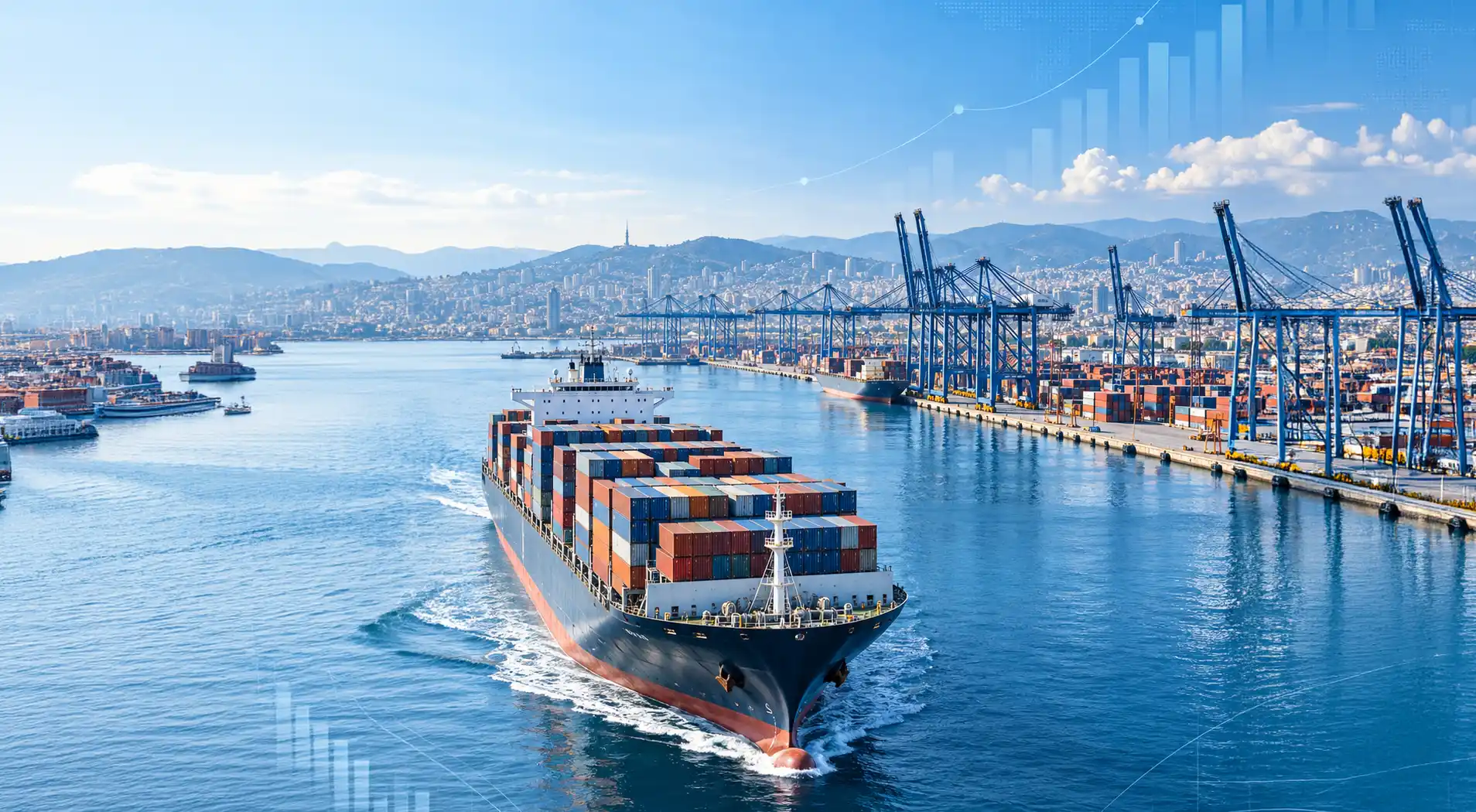
Turkish Port Statistics: September 2026 – Latest Cargo and Container Handling Data
Turkish ports handled a total of 42,380,097 tonnes of cargo in September 2026. Total cargo volume decreased by 1.2% compared with the same month of the previous year, while container handling increased by 7.6% to 1,191,577 TEU. During the January–September period, total cargo handling reached 412,147,102 tonnes, while container throughput rose to 10,766,183 TEU.[1][2]
The September figures indicate a divergence between different segments of Turkish port activity. While international cargo volumes declined, transit and cabotage traffic increased. Container operations also maintained a stronger performance than overall cargo tonnage.[1][2]
Overview of Turkish Ports in September 2026
The total volume of cargo handled at Turkish ports declined by 1.2% year-on-year to 42,380,097 tonnes in September. During the January–September period, total cargo throughput increased by 0.6% compared with the same period of 2025.[1]
| Indicator | September 2026 | YoY Change |
|---|---|---|
| Total cargo handled | 42,380,097 tonnes | -1.2% |
| International cargo traffic | 29,508,353 tonnes | -6.2% |
| Outbound international cargo | 10,641,930 tonnes | -4.6% |
| Inbound international cargo | 18,866,423 tonnes | -7.1% |
| Transit cargo | 6,042,451 tonnes | +8.2% |
| Cabotage cargo | 6,829,293 tonnes | +16.9% |
The main cargo breakdown is also mathematically consistent with the overall total:
29,508,353 + 6,042,451 + 6,829,293 = 42,380,097 tonnes.
While international cargo traffic declined, transit cargo increased by 8.2% and cabotage cargo rose by 16.9% year-on-year.[1]
Kocaeli Ranked First in Cargo Handling
The highest cargo handling volume in September 2026 was recorded within the administrative boundaries of the Kocaeli Regional Port Authority. Port facilities in Kocaeli handled 6,900,965 tonnes, followed by Aliağa with 6,648,439 tonnes and İskenderun with 5,390,533 tonnes.[1]
The top 10 port regions shown in the Ministry’s chart were:
| Rank | Port Region | Cargo Handled |
|---|---|---|
| 1 | Kocaeli | 6,900,965 tonnes |
| 2 | Aliağa | 6,648,439 tonnes |
| 3 | İskenderun | 5,390,533 tonnes |
| 4 | Ceyhan | approx. 4.41 million tonnes |
| 5 | Mersin | approx. 3.76 million tonnes |
| 6 | Tekirdağ | approx. 3.37 million tonnes |
| 7 | Ambarlı | approx. 2.74 million tonnes |
| 8 | Gemlik | approx. 1.40 million tonnes |
| 9 | Zonguldak | approx. 1.33 million tonnes |
| 10 | Çanakkale | approx. 0.91 million tonnes |
Based on the values shown in the official chart, the top 10 port regions handled approximately 36.86 million tonnes, corresponding to roughly 87.0% of total cargo throughput.
The Ministry bulletin also includes a textual figure of 36,091,277 tonnes / 85.2% for the top 10 ports. However, this figure does not align with the chart values or the overall cargo total. For this reason, the chart-based figures are used here when presenting the regional ranking.[1]
Cargo Handling by Cargo Type
Liquid bulk cargo was the largest cargo category in September 2026, with 13,770,632 tonnes handled. Liquid bulk volumes increased by 4.8% year-on-year, while cargo transported in containers increased by 5.8%.[1]
| Cargo Type | September 2026 | YoY Change |
|---|---|---|
| Liquid bulk cargo | 13,770,632 tonnes | +4.8% |
| Cargo transported in containers | 12,080,489 tonnes | +5.8% |
| Dry bulk cargo | 11,094,487 tonnes | -11.8% |
| General cargo | 4,547,323 tonnes | -4.5% |
| Cargo transported in vehicles | 887,166 tonnes | -11.0% |
The combined volume of these five cargo categories equals the total cargo handled at Turkish ports:
13,770,632 + 12,080,489 + 11,094,487 + 4,547,323 + 887,166 = 42,380,097 tonnes.
Among individual cargo commodities, coke and semi-coke recorded one of the most significant monthly increases. A total of 1,298,224 tonnes was handled in September, representing an increase of 323% compared with August. Crude oil handling also increased by more than 914 thousand tonnes month-on-month.[1]
Portland Cement Was the Leading Outbound Cargo
Excluding cargo transported in containers and vehicles, Portland cement was the largest cargo commodity shipped from Turkish ports to overseas destinations in September, with a total volume of 887,518 tonnes.[1]
| Outbound Cargo | Volume |
|---|---|
| Portland cement | 887,518 tonnes |
| Clinker | 515,722 tonnes |
| Coiled steel sheet | 394,322 tonnes |
| Iron and steel products | 333,942 tonnes |
| Reinforcing steel bars | 323,570 tonnes |
For inbound cargo, crude oil ranked first with 3,015,337 tonnes.[1]
| Inbound Cargo | Volume |
|---|---|
| Crude oil | 3,015,337 tonnes |
| Coal | 1,779,878 tonnes |
| Scrap iron | 1,494,135 tonnes |
| Coke and semi-coke | 1,251,694 tonnes |
| Diesel fuel | 988,893 tonnes |
Italy Led Outbound Seaborne Cargo, Russia Ranked First for Inbound Cargo
Italy was the leading destination for cargo shipped from Turkish ports by sea in September, with 1,225,555 tonnes. Egypt and the United States followed.[1]
| Destination Country | Volume |
|---|---|
| Italy | 1,225,555 tonnes |
| Egypt | 1,064,728 tonnes |
| United States | 982,404 tonnes |
| Spain | 685,417 tonnes |
| Greece | 582,835 tonnes |
For cargo arriving at Turkish ports, Russia ranked first with 3,615,406 tonnes, followed by the United States and Egypt.[1]
| Origin Country | Volume |
|---|---|
| Russia | 3,615,406 tonnes |
| United States | 1,437,787 tonnes |
| Egypt | 1,310,420 tonnes |
| China | 884,113 tonnes |
| Oman | 868,781 tonnes |
Container Handling Increased by 7.6%
Turkish ports handled 1,191,577 TEU in September 2026, representing a 7.6% year-on-year increase. During the January–September period, total container throughput rose by 2.7% to 10,766,183 TEU.[2]
| Container Indicator | September 2026 | YoY Change |
|---|---|---|
| Total containers | 1,191,577 TEU | +7.6% |
| International containers | 891,309 TEU | +7.9% |
| Outbound containers | 452,703 TEU | +8.9% |
| Inbound containers | 438,606 TEU | +6.9% |
| Transit containers | 214,882 TEU | +0.8% |
| Cabotage containers | 85,386 TEU | +25.8% |
The container breakdown also matches the overall total:
891,309 + 214,882 + 85,386 = 1,191,577 TEU.
The strongest annual increase was recorded in cabotage container traffic, which rose by 25.8%.[2]
Ambarlı Led Container Handling
The highest container throughput in September was recorded within the administrative boundaries of the Ambarlı Regional Port Authority, where 279,294 TEU was handled. Tekirdağ followed with 198,314 TEU, while Kocaeli handled 198,157 TEU.[2]
| Rank | Port Region | Container Throughput |
|---|---|---|
| 1 | Ambarlı | 279,294 TEU |
| 2 | Tekirdağ | 198,314 TEU |
| 3 | Kocaeli | 198,157 TEU |
| 4 | Mersin | approx. 178,340 TEU |
| 5 | Aliağa | approx. 151,830 TEU |
Based on the values displayed in the Ministry’s chart, the top five regions handled approximately 1.006 million TEU, corresponding to roughly 84.4% of total container throughput.
The bulletin text states a combined figure of 1,005,375 TEU, but this does not fully align with the individual values shown in the same bulletin. Therefore, the chart-based figures are used here for consistency.[2]
Egypt Ranked First in Container Traffic
Egypt was the leading country in terms of container traffic with Turkish ports in September. A total of 200,596 TEU was handled in Egypt-related trade.[2]
This total consists of:
- 96,975 TEU outbound,
- 83,115 TEU inbound,
- 20,506 TEU transit containers.
These components total 200,596 TEU.
Egypt was followed by Greece with 134,000 TEU and China with 104,506 TEU.[2]
The chart in the official bulletin displays 200,506 TEU as the top-line figure for Egypt, while the underlying components and the bulletin text confirm 200,596 TEU. Therefore, 200,596 TEU is used in this article.[2]
Loaded Containers Accounted for 72.5%
A total of 863,437 TEU of loaded containers and 328,140 TEU of empty containers were handled at Turkish ports in September. Loaded container throughput increased by 6.7% year-on-year, while empty container handling increased by 8.9%.[2]
Loaded containers represented:
- 72.5% of total container throughput,
- while empty containers accounted for 27.5%.
By container size, the total 1,191,577 TEU consisted of:
- 270,143 TEU of 20-foot containers,
- 910,618 TEU of 40-foot containers,
- 10,816 TEU of containers larger than 40 feet.
These figures correspond to shares of 22.7%, 76.4% and 0.9%, respectively.[2]
What Do the September 2026 Turkish Port Statistics Show?
September 2026 data indicate that overall cargo tonnage at Turkish ports remained slightly below the previous year’s level, while different transport segments followed contrasting trends. International cargo volumes declined, whereas transit and cabotage traffic continued to expand.
The container segment delivered a stronger performance. Total container throughput increased by 7.6%, international container traffic rose by 7.9%, and cabotage container handling increased by 25.8%.[1][2]
During the first nine months of 2026, Turkish ports handled 412.1 million tonnes of cargo and 10.77 million TEU of containers, underlining the continued scale of Türkiye’s port and maritime transport operations.[1][2]
Sources
[1] Republic of Türkiye Ministry of Transport and Infrastructure, Directorate General of Maritime Affairs, Cargo Statistics – September 2026, Bulletin Y-076, 12 October 2026.
[2] Republic of Türkiye Ministry of Transport and Infrastructure, Directorate General of Maritime Affairs, Container Statistics – September 2026, Bulletin K-076, 12 October 2026.
[3] Republic of Türkiye Ministry of Transport and Infrastructure, Directorate General of Maritime Affairs, Monthly Publications – 2026.